Guides
Which DJ equipment brands actually hold up on the road?
Road durability in DJ gear comes down to serviceable parts, repair turnaround and how each brand handles a failure of faders or jog wheels mid-tour.
What to take away
- Road life rests on three checkspart replaceability, distance to a service centre, and how common the unit is locally. Spec sheets rarely answer them.
- Fader and jog life is the first failure point on club-standard media players and controllers.
- Rider acceptance decides which brands a touring DJ can actually carry into a venue.
- Buy the case, the spare and the service contact before the second unit of anything.
- Track failures per unit per year; that number prices your next purchase.
What actually fails on the road
Gear dies in predictable order. Faders wear, jog wheels drift, encoders skip, headphone jacks crack, and power supplies cook in a hot trailer. Cosmetic scratches never end a gig. A dead channel fader at 11pm does.
What fails on the road
- Faderswear out
- Jog wheelsdrift
- Encodersskip
- Headphone jackscrack
- Power suppliescook in hot trailer
So the durability question is not which brand is strongest. It is which brand gets you running again before the next date.
Score each unit out of five on parts, service distance and commonality, then rank the brands below on the total. Anything under 10 out of 15 stays home on a long run.
A unit that fails more than once a year is a replacement candidate, not a repair candidate.
The brands, and where each one earns its place
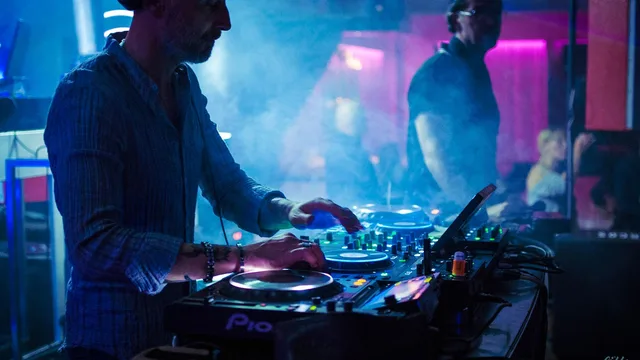
Pioneer DJ (now AlphaTheta) owns the club standard. CDJ and DJM units are in most booths, so a rider asking for them is rarely refused, and a replacement is usually a phone call away in any city with a scene.
Brand service and spares
Pioneer DJ
- Club standard
- Yes
- Replacement nearby
- Usually
- Repair path
- Authorised centres
- Cost / trade-off
- High, holds value
Denon DJ
- Club standard
- No
- Replacement nearby
- Carry spare
- Repair path
- Own spare
- Cost / trade-off
- No club pricing
Rane
- Club standard
- No
- Replacement nearby
- Smaller network
- Repair path
- Long service
- Cost / trade-off
- Higher entry
Native Instruments
- Club standard
- No
- Replacement nearby
- Carry backup
- Repair path
- Laptop dependency
- Cost / trade-off
- Failed set risk
The trade-off is cost and a repair queue that runs through authorised service centres. Buy the flight case; the resale value holds.
Club-standard media players typically sell for $2,000 to $3,500 each, and club mixers for $2,000 to $3,500. A fader or jog repair typically runs 7 to 14 working days at an authorised centre, plus 3 to 5 days shipping each way. Parts not held regionally typically take 2 to 6 weeks to arrive.
AlphaTheta is the parent brand behind the Pioneer DJ line and its newer standalone hardware. Treat it as the same service network and the same parts pipeline.
Denon DJ is the main alternative for DJs who want standalone players and a Prime ecosystem without club-standard pricing. Its SC and Prime series are widely used by mobile and wedding operators. Fewer booths stock them, so carry your own spare.
Denon standalone players typically sell for $1,200 to $2,000 each, and all-in-one Prime units for $2,000 to $2,500. Parts lead times typically run 2 to 6 weeks where the dealer network is thin.
Rane builds mixers and rotary units aimed at installed club and high-end touring use. Long service life, higher entry price, and a smaller dealer network.
Native Instruments covers Traktor controllers and software. Strong for studio and controller-based sets; laptop dependency means a failed controller is a failed set unless you carry a backup mapping.
Numark sits at the entry and mid tier for mobile DJs and bar residencies. Cheap enough to keep a spare in the van, which is its own form of reliability.
Entry controllers typically sell for $200 to $500, and mid-tier models for $600 to $1,200. Bench labour on an entry unit can approach the price of the unit itself, so repair economics differ from club gear.
Reloop makes controllers, turntables and accessories at mid pricing, with a following among scratch and battle DJs. Parts availability varies by region, so check your local distributor before committing a tour to it.
Technics SL-1200 turntables are the long-run reference for vinyl and hybrid sets. Heavy, mechanical, and repairable by any competent turntable tech.
Shure and Sennheiser cover microphones and wireless. For weddings and corporate work, a dropped wireless channel is the most visible failure you can have, so carry spare capsules, cables and batteries.
QSC, Electro-Voice and JBL Professional cover powered speakers and subs. All three are common in rental fleets, which matters more than any single spec: if a sub fails, you want the rental house two suburbs away to stock the same box.
Chauvet DJ and ADJ cover lighting. Both are widely stocked, and moving heads and wash fixtures are the parts most likely to be knocked in transit, so case them properly.
Ranked by how fast a failure becomes a working rig:
| Rank | Brands | Road score | Verdict |
|---|---|---|---|
| 1 | Pioneer DJ (AlphaTheta) | 5 of 5 | Best for touring and rider work |
| 2 | Denon DJ | 4 of 5 | Best alternative; avoid if the rider names Pioneer |
| 3 | Rane, Technics | 4 of 5 | Best for clubs, vinyl and hybrid sets |
| 4 | Native Instruments, Reloop | 3 of 5 | Best mid-tier controllers; avoid without a backup |
| 5 | Numark | 3 of 5 | Best budget tier; avoid for club-standard riders |
| 6 | Shure, Sennheiser | 4 of 5 | Best for wireless; avoid single-channel kits |
| 7 | QSC, Electro-Voice, JBL Professional | 4 of 5 | Best for rental-fleet matching; avoid mixed fleets |
| 8 | Chauvet DJ, ADJ | 3 of 5 | Best stocked lighting; avoid uncased transport |
A worked example of the buy decision
A two-person mobile operation runs 60 events a year. One controller fails mid-reception and the DJ finishes on a backup laptop and a borrowed mixer. The direct cost is a repair. The real cost is the hours spent sourcing a loaner and the referral that does not come.
Three numbers drive it. E is failures per unit per year, F is the typical cost of one failure, and C is the cost of a spare. In the example below, E is 0.375, F is $400 and C is $600.
Buy decision arithmetic
- Events per year: E
- Failure rate per unit per year: F
- Cost of a failed event: C
- Annual expected failure cost: E x F x C
- Compare with price difference plus spare
- If larger, cheap unit is expensive
Across four units, E x F gives about $600 of expected failure cost a year, close to the price of one mid-tier spare. Substitute your own E, F and C; nobody else's figures apply to your calendar.
Paperwork that decides what you can carry
Venue and insurer requirements shape gear choices as much as sound does. Many venues ask for a certificate of insurance before load-in, and the American Disc Jockey Association publishes guidance on the limits mobile operators are commonly asked to hold. Confirm your own limits with your insurer and the venue, not with a forum post.
Coverage limits decide how big a rig you can load in.
Paperwork before load-in
- Certificate of insurance for venue
- Confirm limits with insurer and venue
- Check music licensing with ASCAP and BMI
- Keep OSHA emergency preparedness guidance
- Keep OSHA safety management guidance
- Use licensed electrician, rigging inspector or OSHA
Music use is separate from equipment. The U.S. Copyright Office report on copyright and the music marketplace sets out how public performance and other uses can run through different rights and licensing paths. A streaming subscription does not cover every use. ASCAP and BMI license public performance; confirm your position with them or a licensed attorney.
For gear, that means a licensed source on your backup device too.
Two OSHA resources are worth having on file even though DJ work is not a construction trade. The emergency preparedness guidance covers evacuation, accountability and contacts, which is what a venue wants to see when a room has to empty.
For gear, label cases and cables so staff can move them fast.
The safety management guidance covers finding and fixing hazards before an incident. Cable runs, load-in routes and rigging are where that applies.
For anything electrical, rigging or sound-pressure related, use a licensed electrician, a rigging inspector or OSHA rather than a supplier's marketing page.
If you are building a first rig rather than replacing one, start with the essentials for a new DJ business and add road-grade cases before you add a second controller.
Common questions
Why does club-standard gear count as durable?
Because a failure is recoverable. If your player is the model in every booth, a nearby DJ or rental house can usually supply one. Exotic gear may be better built and still cost you the gig.
Is a cheaper brand ever the right call?
Yes, where the failure is cheap to absorb and the part is common. Any tier with no parts channel in your market is the wrong call, because the repair will outlast your calendar.
How do I check a brand before a tour?
Ask the distributor for parts lead times, find the nearest authorised service centre, and ask two working DJs in your market how long their last repair took. Those three answers predict road life better than any spec sheet.